Agentic Commerce 101: How Selling Through AI Assistants Works
Last updated on July 8, 2026
Ask our AI advisor
A live voice session with the AI advisor that has this article, and years of our experience building production voice AI systems, behind it. Answers now, nothing to schedule.
Want a human instead?
Book a call with our engineersIn September 2025, OpenAI let shoppers buy inside ChatGPT: ask for a pair of headphones, compare options, and pay without leaving the chat. Stripe built the payment rails, Etsy and a wave of Shopify brands signed on, and “buy in the chat” looked like the next commerce channel.
By March 2026, OpenAI had walked it back. A few dozen merchants went live, not the million-plus promised. Discovery itself worked – for some retailers ChatGPT drove about twice the new-customer rate of search – but shoppers who found a product in the chat still left to pay for it. What survived is narrower: the assistant handles discovery, and the purchase completes on the merchant’s own checkout.
That narrower version is agentic commerce today. An AI assistant – ChatGPT, Gemini, Claude – researches products, compares options, and hands a ready-to-buy shopper to a checkout the merchant still owns. For anyone who sells online, or builds the checkout and payment rails others sell on, it raises three practical questions:
- How does selling through an AI assistant work today?
- Can you connect your store to ChatGPT, Gemini, or Claude right now?
- If you run a US store, what are the concrete steps?
Everything below is current as of July 2026.
How selling through an AI assistant works today
Picture a shopper typing into ChatGPT: “comfortable black walking shoes under $150, in stock in EU 42.” The assistant reads product data from stores that made their catalog available, shows a few matching options, and the shopper picks one.
Then the shopper checks out on the merchant's side
- Shopper Taps buy, opens the store
- Store checkout Store checkout opens
- Shopper Pays with existing methods
- Merchant Creates the order
- Shopper Opens the merchant's app in chat
- Merchant app Cart, tax, shipping on merchant infra
- Shopper Pays through the app's checkout
- Merchant Creates the order
Retired Native in-chat checkout — paying without leaving the assistant — was OpenAI's Instant Checkout. OpenAI walked it back in March 2026 after only a few dozen merchants went live and shoppers researched in chat but bought elsewhere.
The assistant runs discovery. The merchant’s checkout and payment stack complete the transaction. Two live paths differ in how the shopper reaches that checkout:
- Storefront handoff: tapping “buy” opens the store’s own checkout in an in-app browser on mobile, or a new browser tab on desktop, with the merchant’s branding and payment methods. This is how Shopify’s Agentic Storefronts channel completes a ChatGPT sale, and it is the dominant path today.
- Merchant app inside the assistant: the merchant runs a dedicated app within ChatGPT, and the purchase completes on the merchant’s own infrastructure through a delegated payment flow. Instacart, DoorDash, and Etsy build on this model. Etsy launched its ChatGPT app in May 2026, with checkout on etsy.com.
A third path, native in-chat checkout, ran for about six months. OpenAI’s Instant Checkout let the shopper pay without leaving ChatGPT, powered by the Agentic Commerce Protocol. Only a few dozen merchants ever went live against the million-plus promised, shoppers researched in chat but bought elsewhere, and Walmart reported in-chat checkout converting roughly 3x worse than a click through to walmart.com. OpenAI pulled it back in March 2026. Expect it referenced as live in older guides; treat those as stale.
Every surviving path keeps the merchant as the seller. The assistant helps the shopper decide and prepare the order; the store owns payment, fulfillment, and support.
Can you connect your store right now?
It depends on where you already sell. Here is the state as of July 2026.
| Surface | What works today | Who can join now | How the sale completes |
|---|---|---|---|
| ChatGPT (storefront handoff) | Products surface via Shopify’s Agentic Storefronts; the shopper finishes on your store | Shopify and Etsy merchants, through their platform | On your own store checkout |
| ChatGPT (merchant app) | A dedicated app inside ChatGPT; checkout runs on your infrastructure | Approved merchants, apply at chatgpt.com/merchants | On your own infrastructure, in-app |
| ChatGPT (native Instant Checkout) | Retired March 2026; discovery stays, native payment removed | Closed | No longer available |
| Google AI Mode and Gemini | Announced; rolling out to eligible US retailers | Eligible US retailers, via the Universal Commerce Protocol | Your checkout, merchant of record |
| Claude | No native checkout | Anyone, but you build the tools | Wherever your tool flow sends the shopper |
Where each platform stands:
- On Shopify or Etsy: products surface in ChatGPT through Shopify’s Agentic Storefronts channel, and Etsy runs its own ChatGPT app. Confirm it is enabled for your store, then focus on making the catalog and checkout ready.
- On another platform: apply through chatgpt.com/merchants to power product discovery and, for eligible merchants, an in-app checkout on your own infrastructure. Approvals are limited today. Prepare your product feed now.
- For Google’s AI shopping: Google announced checkout on its AI surfaces and is rolling it out to eligible US retailers through the Universal Commerce Protocol. Treat it as rolling out, not a guaranteed live path for every retailer yet.
- For Claude: there is no store to “connect.” Claude shops only through tools a developer builds, so treat it as a build-your-own path.
Steps for a US store
The right steps depend on your platform. None of them require building a payment protocol.
- Confirm your products are discoverable. Shopify says eligible products can be surfaced in ChatGPT through its Agentic Storefronts channel; check whether it is enabled in your admin.
- Clean the catalog an agent will read: clear titles, real variants (size, color, SKU), current inventory, accurate price, honest images, readable shipping and return policies.
- Test your checkout in a mobile in-app browser. ChatGPT completes many sales there, so a checkout that only works well on your full desktop site will lose orders.
- Nothing to build for payments. Your existing processor and checkout do the work.
- Apply to appear in ChatGPT at chatgpt.com/merchants. This powers product discovery, plus in-app checkout on your own infrastructure for eligible merchants. Access is limited to approved partners today, so treat it as a queue, not a switch.
- Prepare a structured product feed now (file upload or API), following OpenAI’s commerce onboarding guide. This is useful even before approval.
- For Google’s AI shopping surfaces, keep your Google Merchant Center feed complete and check eligibility for the Universal Commerce Protocol.
- Make sure your own checkout can be reached and completed from a link, so a storefront-handoff flow works cleanly.
Either way, you need a catalog software can read and a checkout a shopper can finish on a phone, not a new payment rail.
Payment, liability, and cost
The money and liability question has a stable answer across OpenAI, Shopify, and Google. Card networks differ on the details – Visa’s Intelligent Commerce and Mastercard’s Agent Pay take different views on who holds the transaction – but the core stays constant.
- You stay merchant of record. The order, payment, refunds, and support run on your existing systems. OpenAI stated this at its Instant Checkout launch, and Shopify keeps the merchant as merchant of record for Agentic Storefronts.
- You keep your payment processor. The assistant does not become your acquirer. It passes a scoped credential or a signed authorization, and your processor charges the card as usual.
- The assistant never sees raw card data. Payment moves through scoped tokens (a credential limited to one merchant, cart, and amount) or signed mandates that record what the shopper approved.
- Cost depends on where the sale completes. A sale finished on your own checkout, through storefront handoff, adds no fee beyond your standard processing. The retired native Instant Checkout charged merchants around 4% on the in-chat purchase, a figure that surfaced at the Shopify rollout rather than at launch; the pivot to discovery and handoff moved OpenAI toward referral-style economics on the traffic it sends. Either way, you keep your existing processor.
A language model tolerates ambiguity; a payment cannot. Payment stays exact and outside the model, held by the store and its processor.
How payment moves
Two live patterns cover almost everything today.
Storefront handoff is the dominant one. The agent surfaces the product, then opens the merchant’s own checkout in a browser. All the store’s existing payment methods, including wallets and bank payment, work unchanged. It is the simplest to support, and the most common.
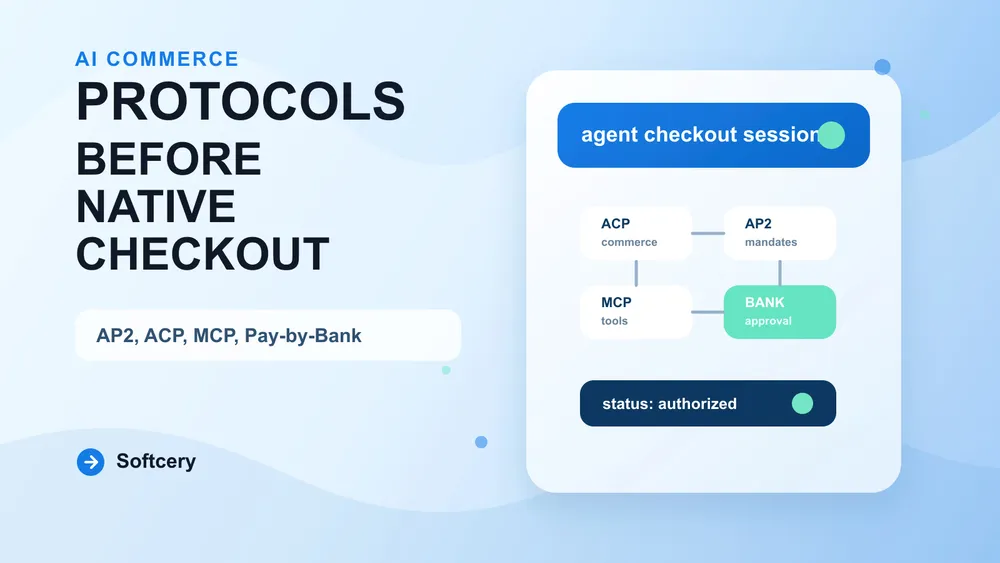
The merchant-app pattern keeps checkout in the assistant but on the merchant’s own infrastructure, and it runs on OpenAI’s Agentic Commerce Protocol, co-developed with Stripe. The merchant exposes checkout-session endpoints (create, retrieve, update, complete, cancel) and accepts a scoped payment token, so the agent completes a purchase without holding card credentials. Payment stays with the merchant’s processor. The same ACP powered the retired native Instant Checkout; it now runs merchant apps like Instacart and DoorDash instead of a checkout OpenAI hosted.
If bank payment (Pay-by-Bank) is your specific interest, the deeper build guide is in the agentic commerce protocols article. For the catalog and product-data layer that makes any of this work, see how to make your store readable by AI shopping agents.
The four protocols
Four names come up constantly. They sit at different layers.
| Name | Owner | Layer it solves |
|---|---|---|
| ACP (Agentic Commerce Protocol) | OpenAI, Stripe | Product, cart, checkout, and delegated payment for ChatGPT |
| UCP (Universal Commerce Protocol) | Product and checkout state for Google’s AI shopping surfaces | |
| AP2 (Agent Payments Protocol) | Google + 60-partner consortium (Mastercard, PayPal, Coinbase) | Proving what the user authorized, through signed mandates, across payment methods |
| MCP (Model Context Protocol) | Anthropic | How an assistant calls external tools; the path for Claude and custom agents |
None of these turn the assistant into a payment processor. They standardize how the store and the assistant exchange product, checkout, and authorization data. Support a protocol shape and you are ready for a channel; you still need the channel, the merchant, and the processor to be live.
What to build regardless of platform
Whichever assistant your customers use, the same commerce primitives apply.
- Structured product and variant data (title, SKU, price, image, stock, policies).
- Server-side cart and checkout-session APIs, not UI that only a browser can drive.
- Explicit user confirmation before any payment.
- Payment authorization through your current processor, wallet, or bank provider.
- Webhooks and status polling so the order is created only after verified payment.
- A checkout that completes cleanly in a mobile in-app browser.
Building the payment layer
Pay-by-Bank providers, wallets, and agentic-checkout startups face a different problem than merchants. Native distribution inside ChatGPT or Gemini is gated and not self-serve, and OpenAI stepped back from hosting checkout itself. The assistants run discovery and leave payment to others. That leaves room for a set of checkout primitives an assistant can call and a merchant can trust.
- Hosted checkout sessions an agent can drive.
- Signed intent that records what the shopper approved.
- A clear authorization handoff to the merchant’s processor.
- Webhooks and status APIs for order state.
- Refund and reconciliation handling.
Ship those and the product plugs into each assistant as its checkout channel matures. The full build is covered in the agentic commerce protocols guide; when a team needs the hands, Softcery builds agentic systems end to end.
What this means for your store
Agentic commerce does not replace your store. It changes which surface the shopper reaches first: assistants handle discovery, stores keep checkout. The website stops being the only storefront, and your catalog, checkout, and order APIs become storefront infrastructure too. A store is ready when a shopper can find it in a chat and finish checkout on a phone.
Frequently Asked Questions
Not the way you could in 2025. OpenAI’s native Instant Checkout, which completed the purchase inside ChatGPT, was retired in March 2026 after weak adoption. Today ChatGPT handles discovery, and the purchase completes on the merchant’s side: either through storefront handoff, where tapping buy opens the store’s own checkout in an in-app browser, or through a merchant app inside ChatGPT that runs checkout on the merchant’s own infrastructure. Both keep the merchant as merchant of record.
If you sell on Shopify or Etsy, those platforms can surface your products in ChatGPT through their own integrations, so you likely do not need a separate application; confirm it is enabled for your store. Other merchants apply to OpenAI at chatgpt.com/merchants (approved partners, US). Google has announced AI-surface checkout and is rolling it out to eligible US retailers through the Universal Commerce Protocol. Claude has no native checkout; it can only act through tools a developer builds with MCP.
No. The assistant helps the shopper decide and prepare the order. The merchant stays merchant of record and charges through the existing payment processor. Payment moves through scoped tokens or signed mandates so the assistant never handles raw card credentials.
A sale completed on your own checkout, through storefront handoff, adds no fee beyond your standard payment processing. The retired native Instant Checkout charged merchants around 4% on the in-chat purchase; since the March 2026 pivot to discovery and handoff, OpenAI’s economics lean toward referral on the traffic it sends rather than a cut of every sale. Either way, you keep your existing processor.
No. Search ranking sends a person to a page to interpret it. AI shopping asks software to understand your product, pick the right variant, verify availability, and hand off to checkout. That depends on structured catalog data and reachable checkout, not meta tags.